


News








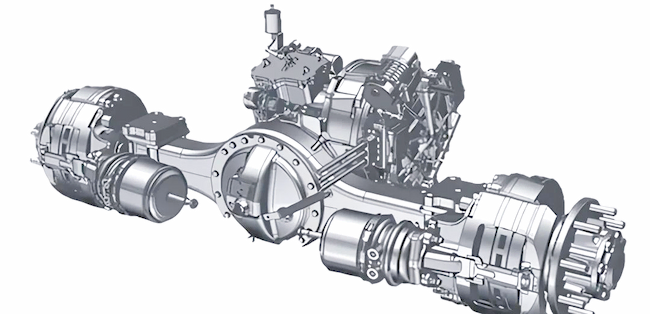
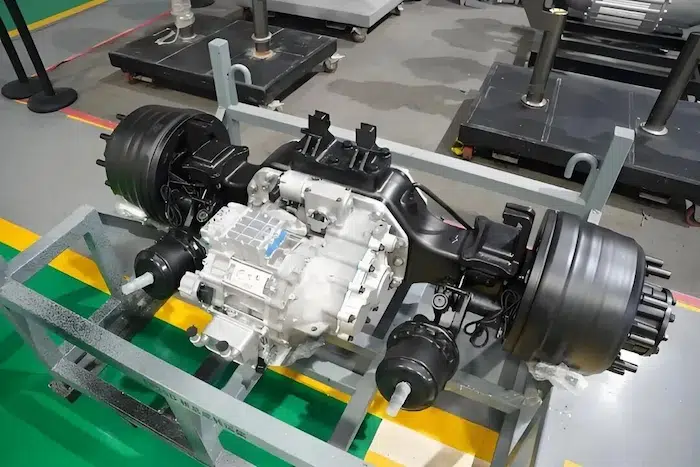
Hub Motor vs PMSM Motor: A Deep Technical-Economic Analysis for Engineers and Decision-Makers
In power system selection meetings, the question "Hub Motor or PMSM?" often sparks deep debates over technical pathways and commercial value. For engineers and procurement decision-makers responsible for product performance, cost control, and long-term competitiveness, this is far from a simple specification comparison. It is a strategic choice concerning product architecture, total cost of ownership, and technology roadmap. This article aims to look beyond basic parameter tables and present, from the three dimensions of systems engineering, lifecycle cost, and market competitiveness, why Permanent Magnet Synchronous Motors are becoming the irreversible choice for high-end applications.
Part 1: Foundational Differences in Technical Architecture — Beyond Just Mounting Location
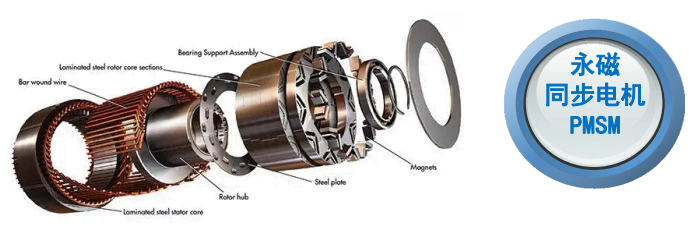
To understand their differences, one must first examine the underlying design paradigms. The Hub Motor is a product of space-driven design, while the PMSM adheres to the philosophy of performance-driven design.
|
Analysis Dimension |
Hub Motor |
Permanent Magnet Synchronous Motor (PMSM) |
|---|---|---|
|
Primary Design Constraint |
Physical Space & Ease of Installation |
Electromagnetic Performance & Thermodynamic Optimization |
|
System Boundary |
Motor and end actuator are tightly coupled, forming a closed system. |
Motor acts as an independent module, optimized in synergy with transmission and control systems. |
|
Maintainability |
Very Low. Failure requires complete disassembly and replacement; high repair cost and long downtime. |
High. Modular design supports predictive maintenance, on-site repair, or rapid replacement. |
|
Platform Scalability |
Weak. Specific wheel size and torque are locked, difficult to adapt to different platform products. |
Very Strong. The same PMSM core can cover a broad spectrum of power-torque requirements by adjusting control software and pairing with different gear reducers. |
|
Pace of Technological Iteration |
Slow. A change in one aspect affects the whole; improvements require re-balancing mechanical structure, electromagnetic, and thermal design. |
Fast. Enables rapid iterative upgrades to electromagnetic design, cooling technology, and material processes independently. |
Insight for Engineers: Choosing a Hub Motor means accepting a performance envelope that is locked in at the initial design stage and difficult to upgrade. Choosing a PMSM is opting for a sustainable, evolvable technology platform that facilitates problem isolation and resolution.
Part 2: Total Lifecycle Cost Analysis — The Hidden Cost Iceberg
Procurement decision-makers are often attracted by the initial BOM cost advantage of Hub Motors, but the true cost plays out over the product's entire lifecycle.
-
Initial Cost vs. Integration Cost:
-
Hub Motors may seem "plug-and-play," but when you factor in the cost of reinforced suspension, higher-grade bearings and braking systems necessitated by increased unsprung mass, and potential additional thermal management measures due to heat dissipation issues, their system-level initial cost advantage shrinks considerably.
-
The PMSM, its matching reducer, and controller do appear upfront on the BOM. However, it allows for more optimal layout at the vehicle or machine level, potentially saving other structural costs. Its value is "visible and quantifiable."
-
-
Energy Cost: The Compound Effect of Efficiency Gap:
Assume a 5kW rated drive system where a PMSM is on average 10% more efficient than a typical Hub Motor. In an industrial scenario operating 8 hours/day with electricity at $0.12/kWh:
-
Annual Extra Energy Cost = 5kW × 8 hours × 365 days × 10% × 175 per unit**.
-
For a factory with hundreds or thousands of units, or a fleet of hundreds of vehicles, over a five-year operational cycle, the savings on electricity costs alone from using PMSMs could far exceed the initial price differential. This is an underestimated, continuously flowing cash flow saving.
-
-
Reliability & Maintenance Cost: Downtime is the Ultimate Luxury:
-
Failures in Hub Motors due to heat buildup are often gradual and difficult to predict. Once they fail, equipment halts immediately, and on-site replacement is complex.
-
The modular design of PMSMs supports condition monitoring. Their operating temperature is controllable, leading to significantly lower failure rates. Even when maintenance is needed, the motor module can usually be replaced quickly, minimizing downtime. For production lines or commercial vehicle fleets, reduced downtime losses and maintenance hours directly translate to higher output and profit margins.
-
-
End-of-Life & Recovery Value:
The high-performance rare-earth permanent magnets (Neodymium Iron Boron) inside PMSMs have clear recovery value. Professional recycling processes can extract these valuable materials, partially offsetting end-of-life costs. Highly integrated Hub Motors are difficult to disassemble for recycling, have low value, and are more often treated as general industrial waste.
Part 3: Performance & Market Competitiveness — The Non-Negotiable Moat
What makes your product stand out in the market? Is it ultimate efficiency, superior experience, or reliable quality?
-
Efficiency as a Product Label:
In the context of global carbon reduction and rising energy costs, efficiency has become hard currency. Products utilizing high-efficiency PMSMs can achieve higher efficiency ratings (e.g., IE5 class), meet the most stringent environmental regulations, and become a powerful marketing feature—whether for "long-range electric vehicles" or "energy-saving industrial pumps."
-
User Experience Defines the Brand:
-
In electric vehicles, the smooth, responsive, and quiet driving experience enabled by PMSMs is key to shaping a premium brand image.
-
In industrial equipment, their precise control capability means higher processing accuracy, better product consistency, and lower scrap rates. This experiential advantage is the foundation upon which customers are willing to pay a premium.
-
-
Future-Proofing Your Technology:
Next-generation motor technologies, such as higher-speed hairpin winding motors, oil-cooled motors, and even deeply integrated "3-in-1" electric drive systems, are inherently based on the PMSM technology roadmap. Choosing a PMSM means your product platform is already prepared to embrace future upgrades like higher power density, greater integration, and more intelligent thermal management. The architecture of the Hub Motor is nearing its physical limits in the face of these advancements.
Decision Matrix: How Should We Choose?
As a decision-maker, you can use the following framework for evaluation:
|
Evaluation Weight |
Scenarios Favoring Hub Motor |
Scenarios Warranting a Firm Shift to PMSM |
|---|---|---|
|
Cost-Driven |
Project budget is extremely tight, AND product lifecycle is very short (<3 years), with no concern for long-term operational costs. |
Focus on Total Cost of Ownership; product has a long lifecycle; sensitive to energy costs. |
|
Performance-Driven |
Requirements for dynamic performance, control precision, and high-speed efficiency are minimal; only basic motion function is needed. |
Pursuing any of: high efficiency, high power density, precise control, wide speed range. |
|
Reliability-Driven |
Application environment is mild, load is very light, operation is intermittent, and consequences of failure are negligible. |
Harsh application environment (high/low temps, continuous heavy load); high reliability and availability are core requirements. |
|
Platform & Iteration |
One-off project with no follow-up model development plans or technology upgrade needs. |
Planning to build a product family; requires technology iteration; needs to reserve space for future feature upgrades. |
Conclusion: From "Component Procurement" to "Value Investment"
For engineers, choosing a PMSM is choosing a superior engineering language. It offers greater design freedom, more controllable thermal management, and more precise performance tuning capabilities, allowing you to push product performance towards its theoretical limits.
For procurement and decision-makers, this is no longer merely a component purchase. Choosing a PMSM is a clear value investment: It trades a slightly higher upfront cost for sustained energy savings over years, significantly reduced maintenance risks, markedly enhanced product competitiveness, and a future-proof, sustainably upgradeable technology platform.
In fierce market competition, a product's advantage often stems from the choice of these underlying core components. While your competitors are still seeking remedies for the heat and bulk of Hub Motors, you can build an insurmountable moat of efficiency, performance, and reliability with PMSMs. It is time to recalculate the cost equation and view the Permanent Magnet Synchronous Motor not as a simple purchase item, but as a core strategic asset driving business growth.